
20 September 2026
Maria Rogers

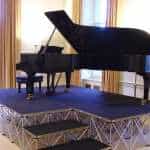
Imagine you’re organising a primary school performance. Thirty children, several teachers, musical instruments and a heavy piano are all using the same portable stage. The stage may look perfectly stable, but there’s more to stage load capacity than simply adding up everyone’s body weight.
A stage has to support people, equipment and other loads through its decking, frames, legs and supporting surface. The way those loads are distributed also matters. A heavy piano, for example, can create concentrated point loads that are very different from the same weight spread evenly across the platform.
That’s why understanding stage load capacity, load distribution and the meaning of kN/m² is important for schools, venues, churches, event planners and anyone responsible for temporary staging.
What Does kN/m² Mean?
kN/m² means kilonewtons per square metre.
It is a measurement of force distributed over an area. Stage manufacturers and structural engineers may use kN/m² when specifying the permitted loading of a platform or stage system.
For a simple conversion:
1 kN is approximately equivalent to 102 kg of force under standard gravity.
So, as a rough conversion, a rating of 5 kN/m² corresponds to approximately 510 kgf/m².
However, this does not mean you can automatically place 510 kg of any type of load anywhere on every square metre of the stage.
The manufacturer’s specifications, support arrangement, span, point-load limitations, configuration and intended use all need to be considered.
Example
Suppose a stage has a stated uniformly distributed load of 5 kN/m² and measures:
- 2 metres wide
- 3 metres deep
- 6 m² total area
Multiplying the area by the stated distributed-load figure gives:
5 kN/m² × 6 m² = 30 kN
That is a mathematical calculation of the total uniformly distributed load corresponding to the stated area rating.
It should not be interpreted as permission to place 30 kN of concentrated equipment or people anywhere on the stage. The manufacturer’s loading conditions and limitations always take priority.
Stage Load Capacity: Static vs Dynamic Loads
One of the most important concepts when assessing stage load capacity is the difference between static and dynamic loading.
Static Loads
A static load is a load that remains relatively stationary.
Examples include:
- A podium
- Stationary chairs
- Tables
- Musical equipment
- A piano
- Fixed stage scenery
- Stationary people
The basic calculation is straightforward: determine the relevant weight or force and establish how it is distributed through the stage.
But even a stationary object can create a significant point load if its weight is concentrated over a small contact area.
Also Read: Why NexGen Spider Staging Riser Legs 1000 mm Are the Best Choice for Indoor Events
Dynamic Loads
Dynamic loads occur when people or equipment move.
Examples include:
- Walking
- Dancing
- Jumping
- Performers moving together
- Equipment being moved across the stage
- Repeated movement or vibration
Dynamic effects can increase the forces experienced by structural components compared with a purely static situation.
There is no universal rule that says you should simply double the calculated load whenever people dance or jump. The appropriate allowance depends on the stage design, intended use and engineering assumptions.
If a stage will be used for energetic performances, dancing or other activities involving significant movement, check that the manufacturer’s specified configuration and loading limits cover that use.
HSE guidance for temporary demountable structures stresses that structures should be used within their specified limitations, including their loading or occupancy limitations.
How to Calculate Stage Load Capacity
A basic load assessment can help you understand what is being placed on a stage.
It should not replace the manufacturer’s technical specifications or a structural engineer’s assessment where one is required.
Step 1: Make a Load Inventory
Start by listing everything that will be placed on the stage.
Include:
- Performers
- Staff
- Speakers
- Amplifiers
- Monitors
- Musical instruments
- Pianos
- Chairs
- Tables
- Podiums
- Props
- Scenery
- Other equipment
Don’t overlook items that may seem relatively small. Several pieces of equipment can add up to a substantial load.
Step 2: Determine the Weight of Each Item
Use actual manufacturer weights whenever possible.
For example:
- 10 performers × 75 kg = 750 kg
- Piano = 200 kg
- Two speakers = 100 kg
Total estimated mass:
750 + 200 + 100 = 1,050 kg
This gives you an estimate of the total mass being placed on the stage.
It does not yet tell you whether the stage is suitable.
Step 3: Calculate the Stage Area
Multiply the stage width by its depth.
For example:
2 m × 4 m = 8 m²
You now know the platform’s total surface area.
Step 4: Calculate Average Distributed Load
If the 1,050 kg from the example above were distributed evenly across the entire 8 m² platform:
1,050 kg ÷ 8 m² = 131.25 kg/m²
Using the approximate conversion between kilograms-force and kilonewtons:
131.25 kg/m² ≈ 1.29 kN/m²
This is an average distributed load, not a complete structural assessment.
The actual stage may have different limitations for point loads, edge loads, supports, spans or particular configurations.
Why Average Load Isn’t the Whole Story
This is where many simple online stage calculations become misleading.
Imagine two scenarios involving the same 200 kg piano.
Scenario A: Distributed Load
The weight is spread across a relatively large area of the deck.
Also Read: Comparing Different Stage Deck Materials: Which One Is Right for You?
Scenario B: Concentrated Load
Most of the weight is transferred through four small wheels or feet.
The total mass is identical, but the way the force reaches the decking and supporting structure is different.
That’s why you should never judge stage load capacity solely by dividing total weight by total floor area.
For heavy or concentrated equipment, check the manufacturer’s point-load requirements and permitted positioning.
What Is a Stage’s Rated Load?
A manufacturer may provide a maximum uniformly distributed load for a particular stage configuration.
For example, a specification might state a value such as:
5 kN/m² uniformly distributed load
But you should always check what conditions apply to that rating.
Questions to ask include:
- Does the rating apply to the complete stage system?
- Which stage dimensions does it cover?
- Does it change with different configurations?
- Are there point-load limitations?
- Are there maximum spans?
- Does it apply to indoor use only?
- Are there restrictions on moving loads?
- Are additional supports required?
- Does the rating apply to accessories or extensions?
A professional supplier should be able to provide clear technical information rather than expecting customers to calculate structural capacity from dimensions alone.
Don’t Confuse Load Capacity With a Safety Factor
A common misconception is that a published load rating is simply the point where a stage physically collapses.
Structural design and testing are more complicated than that.
The published capacity should be interpreted according to the manufacturer’s technical documentation and the applicable design or testing basis. Safety factors may already be incorporated into engineering calculations, depending on the design method and standard used.
For this reason, it is not appropriate to invent a universal rule such as:
“The stage is rated at 5 kN/m², so only use 2.5 kN/m².”
Instead, follow the manufacturer’s stated limitations and seek competent engineering advice if your planned use falls outside the documented configuration.
Stage Load Capacity for Different Events
There is no single kN/m² figure that automatically applies to every event.
A corporate presentation with one speaker and a lightweight podium has different loading requirements from a school production with dozens of performers and instruments.
A dance performance may introduce different dynamic effects from a static exhibition.
A stage carrying a piano, large speaker stacks or scenery may also require consideration of concentrated loads.
Rather than choosing a stage based on a generic “recommended kN/m² for events” table, identify:
- The number of people expected on the platform
- Their approximate combined mass
- Equipment and prop weights
- Concentrated or point loads
- Expected movement
- Stage dimensions
- Stage configuration
- Indoor or outdoor use
- Ground or floor conditions
- The manufacturer’s permitted loading and configuration
For temporary event structures, UK guidance emphasises selecting an appropriate design, ensuring adequate stability and strength, and obtaining evidence of loading capacity and the structure’s ability to withstand relevant forces.
Outdoor Stages: Ground and Environmental Loads Matter
For outdoor staging, stage load capacity is only one part of the safety assessment.
You also need to consider:
- Ground bearing capacity
- Uneven or soft ground
- Drainage
- Anchoring
- Ballast
- Wind
- Weather conditions
- Stage configuration
- Additional equipment such as banners, screens or lighting
HSE event guidance highlights ground conditions, load-bearing capacity, anchoring, extreme weather and wind loading when determining where temporary structures such as stages should be positioned.
A stage that is structurally suitable for its vertical load may still be unsuitable for a particular outdoor installation if the ground or environmental conditions are outside the manufacturer’s specified limits.
What Should You Do If a Stage Starts Moving?
Visible movement, unexpected deflection, damaged components or unusual instability should never be ignored.
If you notice a potential structural problem:
- Stop using the stage if it is safe to do so.
- Keep people away from the affected area.
- Do not add more equipment or people.
- Check the manufacturer’s instructions and limitations.
- Have the structure assessed by an appropriately competent person where necessary.
Do not attempt to determine structural safety simply by listening for creaking or looking for a visible “bounce.” Some problems may not be obvious from visual inspection alone.
HSE guidance emphasises that temporary structures should be properly designed and used within their specified limitations, with appropriate management and inspection arrangements.
What Documentation Should You Ask a Stage Supplier For?
If you’re buying or hiring portable staging, ask for documentation that explains how the system is intended to be used.
Depending on the product and application, useful documentation may include:
- Technical specification
- Stated load capacity
- Point-load limitations
- Approved configurations
- Assembly instructions
- Installation requirements
- Inspection guidance
- Maintenance instructions
- Applicable standards
- Test or engineering documentation
- Outdoor-use limitations
- Wind or anchoring requirements where applicable
For temporary demountable structures, event guidance also identifies design information, calculations, risk assessments, method statements and completion/sign-off documentation as relevant documentation depending on the structure and event.
Stage Load Capacity: A Practical Example
Let’s put the calculation into context.
Suppose you’re organising a school performance on an 8 m² stage.
The planned load is:
- 12 performers at 50 kg each = 600 kg
- 2 teachers at 75 kg each = 150 kg
- Musical equipment = 150 kg
- Props = 100 kg
Total estimated mass:
600 + 150 + 150 + 100 = 1,000 kg
Average load:
1,000 kg ÷ 8 m² = 125 kg/m²
Approximate force per square metre:
125 kg/m² ≈ 1.23 kN/m²
This gives you an average distributed load estimate.
But before using the stage, you would still need to check the actual manufacturer’s specifications, because the calculation does not account for point loads, stage configuration, support spacing, dynamic effects or other limitations.
That distinction is critical.
Stage Load Capacity Checklist
Before your event, check:
- What is the manufacturer’s stated load rating?
- Does it apply to your exact configuration?
- Is the rating based on distributed loading?
- Are there restrictions on concentrated loads?
- What are the weights of the people and equipment?
- Where will heavy items be positioned?
- Is the supporting floor or ground suitable?
- Are all connections correctly installed?
- Has the stage been inspected before use?
- Do you have the relevant supplier documentation?
If you cannot answer these questions, contact the supplier before loading the stage.
Final Thoughts on Stage Load Capacity
Calculating stage load capacity is more than adding up the weight of everyone attending an event.
The kN/m² figure is an important starting point, but it needs to be considered alongside load distribution, concentrated loads, stage configuration, supports and the surface beneath the structure.
For a straightforward setup, a basic load audit can help you understand what is being placed on the platform.
For unusual, heavily loaded or complex structures, rely on the manufacturer’s documented capacity and appropriate professional advice rather than an online calculation.
Choose Staging With Clear Load Information
NexGen Portable Stage provides portable staging systems for applications including schools, venues, performances and events.
When comparing a staging system, ask for clear information about its load capacity, permitted configurations, assembly requirements and supporting documentation.
Planning a new staging setup? Contact our experts to discuss your requirements and find a configuration suited to your venue and intended use.
Author

Hi, I’m Maria Rogers, a writer passionate about event planning, stage design, and portable staging solutions. With years of experience exploring creative and functional setups for performances and gatherings, I enjoy sharing insights to help you create memorable events with ease and style.