
19 September 2026
Maria Rogers

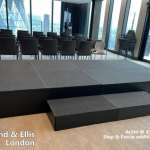
When you hire, buy or operate a portable stage in the UK, safety documentation matters just as much as the physical platform. But there is an important point to understand: portable stage regulations in the UK are not covered by one single standard that applies to every type of stage.
BS EN 13814 is often mentioned in discussions about temporary structures and event equipment. However, its actual scope is more specific. The current BS EN 13814-1:2019+A1:2024 standard covers the design, calculation, manufacture and installation of amusement rides and amusement devices, including certain mobile and temporary structures. BSI also lists structures that fall outside its scope.
For a portable stage, you therefore need to consider the type of structure, how it will be used, where it will be installed and which standards and legal requirements apply.
Here is what UK venue managers, schools and event organisers should know.
What Is BS EN 13814?
BS EN 13814 is a European and British standard covering the safety of amusement rides and amusement devices.
The current Part 1 standard, BS EN 13814-1:2019+A1:2024, deals with design and manufacture. Part 2 covers operation, maintenance and use, while Part 3 covers inspection requirements.
Its scope includes certain mobile, temporary or permanent structures associated with leisure and amusement activities.
However, it does not automatically apply to every portable stage or temporary platform. BSI specifically identifies several types of structures outside its scope, including grandstands and scaffolding. For structures outside the standard’s scope, the relevant standards and requirements need to be considered instead.
This distinction is important when researching portable stage regulations in the UK.
Portable Stage Regulations UK: Standards vs Law
A British Standard and a UK law are not the same thing. A standard provides technical requirements or recognised good practice for particular products or activities. UK health and safety law creates legal duties that may apply depending on the circumstances.
For temporary event structures, organisers and suppliers need to consider factors such as:
- The intended use of the stage
- Structural design and load capacity
- Ground and site conditions
- Assembly and dismantling procedures
- Weather and wind conditions
- Access and edge protection
- Inspection and maintenance
- Risk assessment
- Competence of the people involved
Government guidance on temporary demountable structures covers the procurement, design, erection and use of structures such as stages, grandstands, marquees and barriers.
Which UK Rules May Apply?
The exact legal requirements depend on the project and how the stage is being used.
Health and Safety at Work etc. Act 1974
The Health and Safety at Work etc. Act provides the wider framework for workplace health and safety. Organisations have duties to protect employees and others who may be affected by their activities.
For a modular stage installation, this means safety should be considered from procurement through to assembly, use and dismantling.
Management of Health and Safety at Work Regulations 1999
Risk assessment is an important part of managing event and workplace risks.
For a portable stage, the assessment should consider factors such as:
- Stage stability
- Load capacity
- Access and egress
- Slips and trips
- Falls from height
- Equipment placed on the platform
- Assembly and dismantling
- Weather conditions for outdoor use
The assessment should reflect the actual stage, location and planned activity rather than relying on a generic document.
PUWER
The Provision and Use of Work Equipment Regulations 1998 (PUWER) can apply to work equipment where its scope and circumstances are met.
Where applicable, equipment should be suitable for its intended use, maintained appropriately and used by people who have adequate information, instruction and training.
Do not assume that a particular British Standard automatically determines whether PUWER applies. The legal requirements should be considered alongside the equipment’s actual use.
What About Temporary Demountable Structures?
Portable stages are often used as temporary demountable structures. UK event guidance highlights the importance of choosing an appropriate design, selecting suitable suppliers, planning the work and inspecting the finished structure. HSE guidance also identifies staging, seating and other temporary structures as important elements of event safety management.
Depending on the event, organisers may need information such as:
- Design specifications
- Construction or assembly drawings
- Structural calculations where required
- Load information
- Risk assessments
- Safe working procedures
- Site plans
- Wind-management arrangements
- Completion or sign-off documentation
Local authority event guidance also recommends keeping relevant design, calculation, risk assessment and wind-management information available for temporary demountable structures.
Understanding Stage Load Capacity
One of the most important areas when selecting a portable stage is load capacity.
Do not judge capacity simply by the number of people standing on the platform.
Consider everything that will be placed or used on it, including:
- Performers
- Speakers
- Musical instruments
- Furniture
- Lecterns
- Lighting equipment
- Displays
- Backdrops
- Other production equipment
The manufacturer’s documentation should clearly state the permitted loading and any restrictions on how loads are distributed.
A concentrated load, such as heavy equipment positioned in one area, may have different structural implications from an evenly distributed load.
For that reason, always follow the manufacturer’s stated limits rather than applying a generic load figure found online.
Outdoor Portable Stages and Wind
Outdoor staging requires additional planning. Wind can affect the stability of temporary structures, particularly where stages include roofs, backdrops, banners, screens or other components that increase exposed surface area.
Before installing an outdoor stage, consider:
- Expected wind conditions
- Ground conditions
- Anchoring requirements
- Ballast requirements
- Stage height
- Additional equipment attached to the structure
- Manufacturer restrictions
- Procedures for monitoring changing weather
The correct method depends on the particular stage and site. Do not add ballast, anchors or other components unless they are suitable for the system and specified by the manufacturer or competent designer.
Assembly Matters
Even a well-designed stage needs to be assembled correctly. The person or team responsible for installation should follow the manufacturer’s instructions and understand the system’s limitations.
Check:
- All components are present
- Connections are correctly secured
- Legs and supports are correctly positioned
- Platforms are properly joined
- Guardrails and access systems are correctly installed where required
- The stage is level and stable
- Load limits are understood
- The completed installation is inspected before use
For larger or more complex temporary structures, competent technical input may be required.
What Documentation Should You Request?
When buying or hiring a portable stage, don’t rely solely on a salesperson’s description.
Ask for documentation relevant to the particular product and intended use.
1. Product Specifications: The documentation should identify the stage system, components, dimensions and permitted configuration.
2. Load Information: Check the manufacturer’s stated load capacity and any restrictions concerning point loads, distributed loads or equipment placement.
3. Assembly Instructions: Clear instructions should explain how the stage should be assembled, configured, used and dismantled.
4. Inspection and Maintenance Information: Find out how the stage should be inspected and maintained and whether particular components require periodic checks or replacement.
5. Relevant Compliance Documentation: Ask the supplier which standards and legal requirements apply to the specific stage and request supporting documentation where appropriate.
Don’t assume that a supplier’s use of the phrase “BS EN 13814 compliant” means the entire stage is automatically covered by that standard. Confirm what the claim relates to and whether the standard is actually applicable to the product.
A Simple Buying Checklist
Before purchasing or hiring a portable stage in the UK, ask:
- What is the stage designed for?
- What is its maximum permitted load?
- How should loads be distributed?
- Is it suitable for indoor, outdoor or both environments?
- What ground conditions are required?
- What wind limits apply?
- What anchoring or ballast is required?
- Who should assemble and inspect it?
- What maintenance is required?
- What documentation does the manufacturer provide?
- Which standards apply to this particular product?
These questions can help you compare suppliers based on documented requirements rather than marketing claims.
The Bottom Line on Portable Stage Regulations UK
There is no single rule that makes every portable stage in the UK compliant.
Portable stage regulations in the UK involve a combination of applicable legislation, relevant standards, manufacturer requirements, site conditions, risk assessment and competent installation.
BS EN 13814 is an important standard, but its scope needs to be understood before applying it to a particular stage. The current standard covers amusement rides and amusement devices and certain associated temporary structures; it should not be treated as a universal certification requirement for every portable stage.
For buyers and venue managers, the safest approach is straightforward: identify the intended use, establish the applicable requirements, obtain the technical documentation and make sure the stage is installed, inspected and used according to its specifications.
That approach gives you a much stronger basis for managing stage safety than simply looking for a certification label.
Planning a Portable Stage?
If you’re comparing portable staging systems for a UK venue, look beyond price. Check the platform configuration, load capacity, assembly requirements, documentation and suitability for your intended use before making a purchase.
🚀 Stop Guessing. Start Securing.
Is your current staging a hidden risk? Don’t wait for an inspection, a failed audit, or an accident to find out. At NexGen Portable Stage, we don’t just build platforms; we build peace of mind. Every stage we manufacture is engineered to meet rigorous safety standards, ensuring your event is legal, insured, and rock-solid.
Ready to upgrade to a compliant, professional system that protects your venue?
👉 Explore our Range of Certified Portable Stages
👉 Request a Safety Consultation for Your Venue
Author

Hi, I’m Maria Rogers, a writer passionate about event planning, stage design, and portable staging solutions. With years of experience exploring creative and functional setups for performances and gatherings, I enjoy sharing insights to help you create memorable events with ease and style.