
Portable Stage Size Guide UK: How to Choose the Right Size for Your Event
Choosing the right portable stage size is one of the most important decisions in event planning. Too small, and performers are cramped, equipment overflows and the show looks amateur. Too big, and you lose audience space, pay for decks you never use and fill half your storage with staging you didn’t need.
This portable stage size guide UK walks you through the whole decision: recommended sizes for each event type, the right stage height for your audience, how to work out exactly how many decks you need, and how to measure your venue so the stage fits first time. To get the most from your portable staging, start with the performance itself — who is on stage, what equipment they bring, and how much room they genuinely need to move.
The short answer: most UK school, church and community events are covered by a 3m × 2m to 6m × 3m stage. Presentations and speeches need 2m × 2m to 3m × 2m, a small band needs at least 4m × 3m, and choirs are usually better on tiered staging than on one large flat stage. Heights run from 200mm for a small hall to 1000mm for a large audience on flat ground.
Portable Stage Sizes At A Glance
NexGen staging is modular and built from 1m × 1m decks, so any size below is simply a deck count. That is what makes the system flexible — start with the size you need today and add decks later.
| Stage size | Decks needed (1m × 1m) | Best for | Typical height |
| 2m × 2m (4m²) |
4 |
Solo speaker, awards, small presentation | 200–400mm |
| 3m × 2m (6m²) |
6 |
Presentations, ceremonies, small school performances | 200–400mm |
| 4m × 2m (8m²) |
8 |
Panel discussions, acoustic acts, assemblies | 300–600mm |
| 4m × 3m (12m²) |
12 |
Small bands, school concerts, conferences | 400–600mm |
| 5m × 3m (15m²) |
15 |
Bands with drums, dance groups, larger productions | 400–600mm |
| 6m × 3m (18m²) |
18 |
Full school productions, choirs (flat), community concerts | 400–800mm |
| 6m × 4m (24m²) |
24 |
Dance performances, large bands, festivals | 600–1000mm |
| 8m × 6m (48m²) |
48 |
Festival and main-stage productions | 800–1000mm |
Complete portable staging packages cover the most popular of these sizes — 3m × 2m, 4m × 2m, 5m × 3m and 6m × 3m, plus a 3-tier choir package — or you can design your stage from individual decks in any other footprint.
How portable stage sizes work
Before comparing sizes, it helps to understand how a modular stage is measured:
- Deck size. NexGen platforms are 1m × 1m, with a 1m × 520mm half deck for filling gaps and building steps and tiers. Your stage footprint is always a combination of whole decks, so a 4m × 3m stage is 12 decks.
- Stage area. Multiply length by depth. A 6m × 3m stage gives you 18m² of performance space — that area figure is the one to plan performers and equipment against.
- Stage height. Height is set by the riser legs, not the decks. NexGen riser heights are 200, 300, 400, 600, 800 and 1000mm, and the same decks can be used at different heights, or combined into tiers.
- Tiered layouts. Choirs and seated performers often need levels rather than area. Tiered staging stacks rows at increasing heights so every row can be seen.
Also Read: Adjustable Height Portable Stages Guide: Why They Matter & Top Picks

How much space does each performer need?
A reliable way to size a stage is to work from the people on it. As a rule of thumb:
- Standing performer or singer: allow about 2m² each
- Seated musician: allow about 3m² each, including chair and music stand
- Dancer or active performer: allow 4–5m² each — movement needs empty floor, not
just standing room - Drum kit: allow about 3m² on its own, plus the drummer
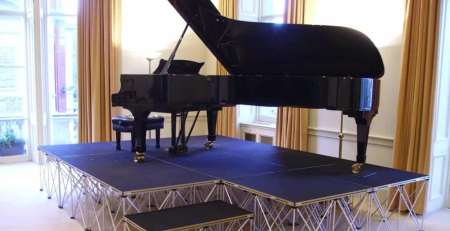
- Grand piano: allow roughly 3m × 2m including the pianist’s bench and lid swing
- Speaker with lectern: 2m × 2m is comfortable for one presenter
Add the performers, then add the equipment, then add a margin for walking on and off. If the total is close to your stage area, go one size up — a stage that is exactly full on paper is cramped in real life.
Recommended stage sizes by event type
Presentations, speeches and awards (1–4 people)
Recommended size: 2m × 2m to 4m × 2m — Height: 200–400mm
A single speaker, an awards presenter or a small panel does not need a large stage — they need to be seen and heard. A 3m × 2m stage at 200–400mm is the standard choice for corporate presentations, award ceremonies and school assemblies: enough room for a lectern, a screen beside the speaker and space to walk on and off, without swallowing the room. Go up to 4m × 2m for a panel of three or four seated speakers
Where you put the stage matters as much as its size — see our guide to Boost Audience Engagement: Optimal Stage Positioning for UK Corporate Presentations
School performances and assemblies
Recommended size: 3m × 2m to 6m × 3m — Height: 200–600mm
School halls host everything from a reception-class assembly to a full Year 6 production, which is why modular staging suits schools so well: build a 3m × 2m stage for weekly assemblies, then extend it to 6m × 3m for the end-of-term show. Keep heights lower for younger children — 200–400mm is plenty in a school hall, and every child can be seen from the back row of chairs.
For a classroom rather than a hall, a single row of decks at 200mm can be enough — see Improving Visibility and Performance in Small Classrooms with a Stage Platform.
Also Read: From Schools to Churches: How Modular Staging Solutions Adapt to Any Event
Also Read: How Portable Staging Can Foster Creativity in School Performances
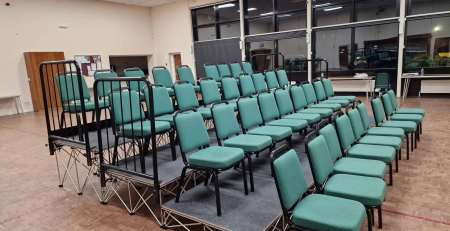
Choirs and tiered staging
Recommended: tiered staging rather than one large flat stage
A choir of 30 on a flat 6m × 3m stage leaves the back rows invisible. Tiered staging solves the sightline problem instead of the space problem: rows stand at increasing heights, so every singer can be seen and heard. NexGen’s 3-tier choir package is built for exactly this, and tiers can also be used for group photographs, seated orchestras and graduation ceremonies. As a planning guide, allow roughly 0.5m of width per singer per row.
Bands and live music
Recommended size: 4m × 3m minimum; 5m × 3m to 6m × 4m for a full band — Height: 400–600mm
Musicians need space for instruments, amplifiers, monitors and cables, not just themselves. A solo pianist fits comfortably on 3m × 2m; a duo or acoustic act on 4m × 2m; a four-piece band with a drum kit needs at least 5m × 3m, and 6m × 4m if backline and lighting are sharing the stage. Keep the drum kit on its own area at the back and leave a clear walkway at the front for the singer.
Also Read: Concert Stages: Elevating Live Music Experiences
Dance performances
Recommended size: 6m × 3m to 6m × 4m or larger — Height: 400–600mm
Dance is the most space-hungry use of a stage. Choreography is planned in travelling steps, lifts and floor work, so measure the largest routine, not the number of dancers. A 6m × 4m stage handles most school and dance-school productions; competitive and contemporary groups often go larger. The surface must be flat, level and free of gaps, and younger dancers generally need more room than experienced performers because their spacing is less precise.

Weddings and Celebrations
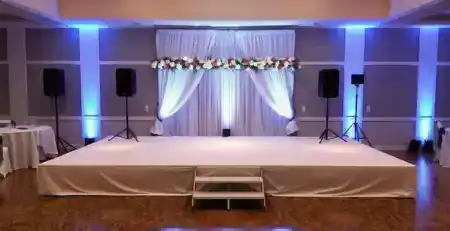
Recommended size: 3m × 2m for the top table or ceremony; 4m × 3m for the band or DJ —Height: 200–400mm
At a wedding the stage is a focal point, not a dance floor — guests dance on the venue floor, while the stage carries the band, DJ, speeches and the first dance spotlight. Low heights (200–400mm) keep the stage elegant and in proportion, and a 3m × 2m platform is enough to lift a ceremony or top table so every guest can see it.
Also Read: Portable Stages for Micro-Weddings: Intimate Yet Elevated
Churches, village halls and community events
Recommended size: 3m × 2m to 6m × 3m — Height: 200–600mm
For churches and halls, the deciding factor is usually the room, not the event: the stage has to fit between fixed features, store away afterwards and be set up by a small team of volunteers. Modular decks are ideal because the same kit can be a 3m × 2m platform for a service, a tiered layout for the choir, and a 6m × 3m stage for the village panto — then store on a trolley when the hall is needed for something else
Festivals and large outdoor events
Recommended size: 6m × 4m to 8m × 6m or larger — Height: 800–1000mm
Large audiences on flat ground need height as much as area: at 800–1000mm the back of the crowd can still see the performers. Festival stages also carry more equipment — full backline, lighting and sound — so plan the footprint around the largest act of the day, and allow separate space at the side for changeovers.
Also Read: 5 Modular Staging Solutions Every Party Organizer Needs to Know
Choosing the right stage height
Height is chosen for the audience, not the performers. The further back your audience sits or stands on flat ground, the higher the stage needs to be:

|
Audience / venue |
Recommended height |
| Small room, audience close to the stage | 200mm |
| School hall, seated audience up to ~100 | 200–400mm |
| Medium hall, 100–200 seated | 400–600mm |
| Large hall or auditorium, 200+ | 600–800mm |
| Outdoor event, standing crowd on flat ground | 800–1000mm |
Three checks before you settle on a height:
- Ceiling height. Add the stage height, the tallest performer and any backdrop or lighting to your room’s ceiling height. Low-ceilinged halls often rule out tall staging.
- Access. Every height needs a safe way up: steps for most stages, and a ramp where performers, equipment or wheelchair users need step-free access.
- Rails. The higher the stage, the more important guard rails become at the back and sides. Plan them into the footprint, especially for schools and dance.
Because NexGen decks sit on separate riser legs, one set of decks can be used at 200mm for an assembly and at 600mm for an evening concert — you are not locked to the first height you choose.
How to measure your venue
Measure the room before you order, and measure the stage’s journey into the room as well as the space it will sit in:
- Usable floor area. Measure the wall-to-wall space, then subtract audience seating, walkways and anything fixed (pillars, a bar, a font, stored chairs). The stage must fit what is left, with at least a walkway around it.
- Ceiling height at the stage position — and at the lowest point, if the ceiling slopes.
- Access route. Door widths, corridors, steps and lifts between the delivery point and the hall. NexGen decks are 1m × 1m and light enough to carry one at a time, so access is rarely a problem, but it is worth a two-minute check.
- Floor. Note slopes, uneven boards or grass. Outdoors, plan a level base and think about drainage after rain.
- Power and cables. Where monitors, lighting and PA will plug in, and how cables will reach them without crossing walkways.
Work out your exact size in decks
The maths is deliberately simple:
Stage area (m²) = number of 1m × 1m decks
So if your performers and equipment need about 15m², you need 15 decks — arranged as 5m × 3m, 6m × 2.5m (using half decks) or any other footprint that fits your room.
Worked example 1 — school production. 24 children on stage at the biggest moment, at roughly 0.6m² each in a grouped scene, plus a scenery flat at the back: about 15–18m². A 6m × 3m stage (18 decks) at 400mm gives every child room, fits a standard school hall and stores on a single trolley afterwards.
Worked example 2 — four-piece band. Drummer and kit 3m², two guitarists and a bassist at 2m² each, singer 2m², amplifiers and monitors 3m²: about 14m². A 5m × 3m stage (15 decks) at 600mm in a medium hall covers it with a small margin.
Worked example 3 — conference panel. Four seated speakers with chairs and a table (about 8m²) plus a lectern: a 4m × 2m stage (8 decks) at 400mm, with the screen hung or stood beside the stage rather than on it.
If your calculation lands between two sizes, choose the larger one if the venue allows it — and remember that with a modular system you can also start with the smaller size and add decks for your biggest event of the year. The online Stage Builder lets you design your stage on screen — lay out your exact footprint, set the height, add steps and rails — and get a quote for it.
Load, safety and stability — what to check

Size is not only about floor area. Before you buy, check:
- Load rating. Check the manufacturer’s rated load for the platform and stay within it, with the weight of performers, instruments and equipment combined. Spread heavy items — a piano, large speaker stacks — rather than concentrating them on one deck.
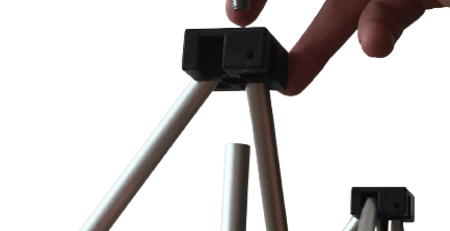
- Level and locked together. A stage must sit level and be properly connected so decks cannot drift apart. NexGen decks connect magnetically with no locks or keys, which removes the loose clamps and Allen keys of traditional systems.
- Edges and access. Fit steps, handrails and ramps to match the height, use skirting/fascia for a finished edge, and add chair stops if seating is placed on the stage.
- Checks before every use. Walk the stage, confirm every deck is seated and stable, and keep cables taped or routed away from walkways.
Also Read: Platform Stage for Sale: What You Need to Know About Load Capacity, Safety, and Ease of Setup
Storage, transport and setup — the size you forget to plan
A stage you own has to live somewhere between events. NexGen decks are designed around this: a 6m × 3m stage stores on a single trolley, and each 1m × 1m Platinum platform weighs just 7.8kg, so one person can carry decks to the hall. Setup is equally quick —the magnetic decks connect without tools, locks or keys, and a 3m × 2m stage builds in around 60 seconds. When you are comparing sizes, count the trolleys and the cupboard, not just the stage: the right size is the largest stage you can store, move and build with the people you actually have.
Common mistakes when choosing a stage size
- Sizing for the audience instead of the performers. Audience size sets the height; the performers and their equipment set the area.
- Forgetting the equipment. Amps, monitors, props, scenery and a drum kit can take a third of your stage. Add them to the calculation.
- No margin. A stage that is exactly full leaves no room to walk on, off or around. Go one size up if you can.
- Ignoring the ceiling. Tall staging under a low ceiling leaves performers ducking under lights and backdrops.
- Buying a choir a flat stage. Choirs need tiers for sightlines, not just more square metres.
- Forgetting access and storage. Check doors, steps and where the stage will be stored before you order the biggest size.

NexGen Magnetic Portable Staging: The Future of Event Platforms
When considering portable staging options in the UK, the innovative NexGen Magnetic Portable Staging PLATINUM RANGE represents a revolutionary approach to event staging. This TOTALLY MAGNETIC environmentally friendly staging deck platform features:
- Sustainable Construction: Recycled core material, sustainably sourced plywood, recycled carpet, and less hazardous adhesives
- Exceptional Performance: Lighter, Faster, Safer & Longer Lasting
- Impressive Specifications: Platform Weight of just 7.8kg with Load Weight capacity of 1500 Kg
- Safety-Focused Design: Child-Safe Friendly Corners with No Locks or Keys required
- Long-Term Value: Lifespan Up to 15 Years
The lightweight nature of these platforms (7.8kg per unit) makes them ideal for venues with limited staff resources, while the impressive 1500kg load capacity ensures they can handle even the most demanding performances. The magnetic connection system eliminates the need for tools or complicated assembly processes, dramatically reducing setup time, so you can design your stage around your venue and rebuild it in a different shape for the next event.
For schools, corporate events, or touring productions where stages must be frequently assembled and dismantled, this innovative system offers significant advantages in both efficiency and safety. The environmental credentials also align with the growing focus on sustainability in event management. Ready to get started? Design your stage with NexGen and choose the size, height, and layout that suit your event.
Why size flexibility matters: the NexGen approach
Traditional staging locks you into the size you bought. NexGen’s magnetic modular system is built in Sheffield from 1m × 1m decks, so the stage you buy for this term’s assembly can be extended for the summer production, split into two smaller platforms for separate rooms, or rebuilt as choir tiers — with no locks, no keys and no tools.
The Platinum range uses a recycled core with a platform weight of just 7.8kg and is built to last up to 15 years, and the same decks are used across complete packages and individual orders, so adding to your staging later never means starting again.
Also Read: The Magic of the Modular Stage Platform: Transforming Spaces with Ease
Portable stage size FAQs
What is the standard size of a portable stage?
There is no single standard, but the most commonly bought sizes in the UK are 3m × 2m, 4m × 2m, 5m × 3m and 6m × 3m, all built from 1m × 1m decks. A 3m × 2m stage suits presentations and small performances; 6m × 3m suits full school productions.
How big a stage do I need for a band?
Allow at least 4m × 3m for a small act, and 5m × 3m to 6m × 4m for a four- or five-piece band with a drum kit, amplifiers and monitors.
What height should a school stage be?
200–400mm suits most school halls and younger children. For larger halls and audiences over about 200, 600mm gives the back rows a clear view.
How many decks do I need for a 6m × 3m stage?
18 — one 1m × 1m deck per square metre. A 6m × 3m NexGen stage stores on a single trolley.
Can I make my stage bigger later?
Yes. With a modular system you add decks and risers to the staging you already own, and the same decks can also be rearranged into tiers or split into smaller stages.
Is a bigger stage always better?
No. An oversized stage eats audience space, costs more and takes more storage. The right size fits your largest regular event, your venue and your storage — and a modular system lets you extend for one-off big events.
Ready to Find Your Perfect Portable Stage Solution?
Selecting the right portable stage platforms size is crucial to your event’s success. With NexGen Magnetic Portable Staging, you’ll benefit from cutting-edge technology that makes setup easier, transportation lighter, and performance safer than traditional staging systems.
Contact us today to discuss your specific event requirements:
Our team of staging experts can help you determine the perfect dimensions for your upcoming event, whether you’re planning a school production, corporate gathering, or major festival. With nationwide delivery across the UK and flexible hire or purchase options, we’ll ensure you have the ideal stage size to make your event a complete success.
Don’t compromise on your staging – invest in a solution that offers the perfect balance of quality, sustainability, and performance. Request your free consultation and quote today!