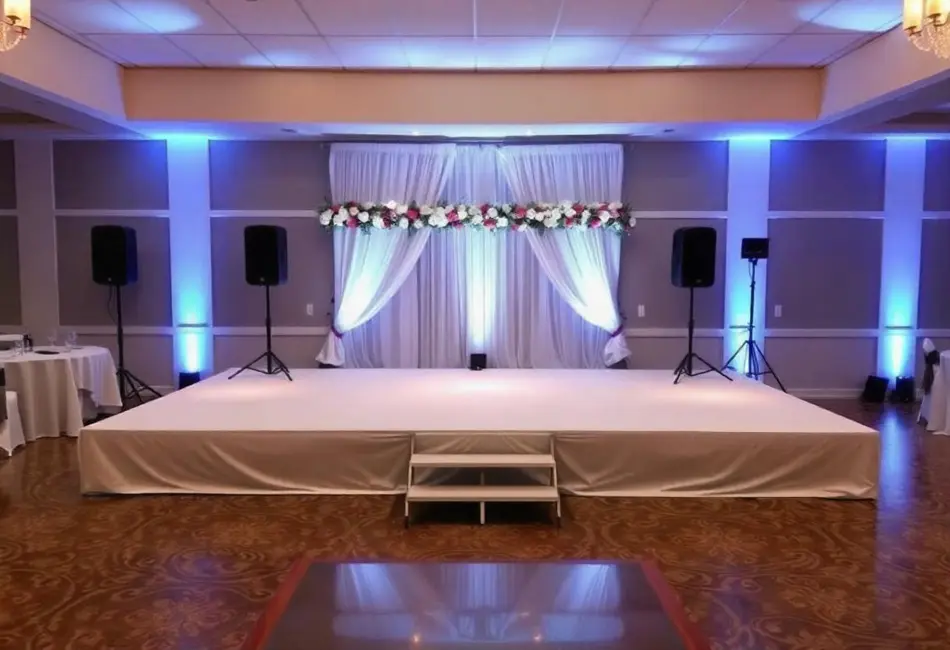

Choosing a stage for care homes is less about putting on a show and more about making the room work for everyone in it. A good stage brings residents, families and visiting performers together — a singer close enough to see properly, a resident reading a poem without feeling exposed, a Christmas sing-along where the front row is not craning its neck. The wrong stage does the opposite: too high, too wobbly-looking, too much faff to set up, so it stays in the cupboard and the lounge stays flat.
This guide walks through what actually matters when you are picking staging for a care home or day centre: safe low heights, step-free access, seating sightlines, and a setup your team can manage between activities without turning the day upside down.
Why a Stage Makes Such a Difference in a Care Setting
Most care home entertainment happens at floor level, and floor level has a problem: only the first row can see. Everyone behind is watching the back of someone’s head. Even a low stage changes that completely. Raising a performer by just 200mm lifts them into everyone’s line of sight, including residents in armchairs and wheelchairs at the back of the room.
A stage also gives an event a sense of occasion. Residents who perform — reading, singing in the choir, joining a seated exercise group — feel they are doing something special rather than something in the corner. For visiting entertainers, a defined performance area helps them settle and helps residents understand where to look and listen. Small thing, big difference to the atmosphere of an afternoon.
Choosing a Safe Height: Low Is Usually Right
In a theatre, height is about drama. In a care home, height is about confidence. Most care settings find that 200mm to 400mm is the working range:
- 200mm suits seated exercise groups, musicians and speakers — a gentle lift that never feels like a climb.
- 300–400mm suits singers, choirs and performances where the audience is seated in rows and sightlines matter more.
Heights above that are rarely needed in a lounge or day room, and they make access harder for everyone. Because NexGen portable staging is built from separate decks and risers, the height is a choice you make each time you build it: risers are available at 200, 300, 400, 600, 800 and 1000mm, so the same decks can sit low for a coffee-morning singer and higher for a summer fete performance in the garden room. Start low. You can always build higher when an event genuinely needs it.
Step-Free Access: Ramps and Handrails
If residents are going to use the stage — and they should be able to — step-free access is not an optional extra. A portable ramp lets a wheelchair user join the choir, present an award or take part in a performance instead of watching from floor level. That is the difference between an inclusive activity and one that quietly excludes.
Handrails matter just as much. A resident who walks with a frame or a stick may be perfectly happy performing, but not happy about the step up or the edge of the stage behind them. A handrail along the back or side gives people something steady to hold and a visible boundary, which makes the stage feel safe rather than precarious. When you are comparing any stage for care homes, ask about ramps and rails first and colours second — access is what decides who gets to take part.
Sightlines for Seated Audiences
Care home audiences are seated audiences, often in chairs that do not move easily. Think about the room from the back row:
- Can a resident in a wheelchair at the back see the performer’s face over the chairs in front? A 300mm stage usually solves this.
- Is the stage wide enough that people at the sides are not watching at a sharp angle? Width helps more than depth in most lounges.
- Does the stage leave a clear route to the doors and the toilets? Never let staging block the paths residents and staff use all day.
Because the decks are 1x1m squares (with a narrower 1x520mm deck for filling gaps), the stage can be shaped to the room — wide and shallow for a lounge, deeper for a hall — instead of forcing the room to fit a fixed platform.
Quick Setup in a Working Lounge
A care home lounge is never empty for long, so staging that takes an hour and a toolkit will not get used. NexGen decks connect magnetically — no locks, no keys, nothing to line up or lose — so a small 3x2m stage, which is six decks, builds in about 60 seconds. Two members of staff can put it up after lunch and take it down before tea, and nobody needs training beyond being shown once.
Weight helps too. A Platinum 1x1m deck weighs 7.8kg, light enough for one person to carry comfortably, which matters when the person setting up is an activities coordinator rather than a stage crew.
Storage in Small Spaces
Day centres and care homes rarely have spare rooms, so where the stage lives matters as much as how it performs. Decks stack flat onto a panel trolley, and a full 6x3m stage stores on a single trolley that wheels into a store cupboard or the corner of an office. Folded into that footprint, the stage stops competing with hoists, wheelchairs and everything else a care setting needs to store. If storage is your biggest worry, our small venue staging solutions page shows how the same approach works in other tight spaces.
A Simple Checklist Before You Buy
- Low heights available (200–400mm) for everyday use
- Ramp access and handrails offered, not improvised
- Decks light enough for your team to carry
- A size that fits your lounge with walking routes left clear
- Storage on a trolley, not a pile in a corridor
- A system you can add to later, one deck at a time
Most homes start with a portable staging package in a lounge-friendly size and add decks later as activities grow.
Get those six right and a stage for care homes stops being equipment and becomes part of the home’s routine — out for the singer on Tuesday, the choir on Thursday, and the residents’ own performances whenever they feel like taking the stage.
— Shared by the team at NexGen Staging Limited, Sheffield manufacturer of magnetic modular portable staging, supplying schools, churches, care settings and venues in and around Sheffield.